Pineapple Upside-Down Burger
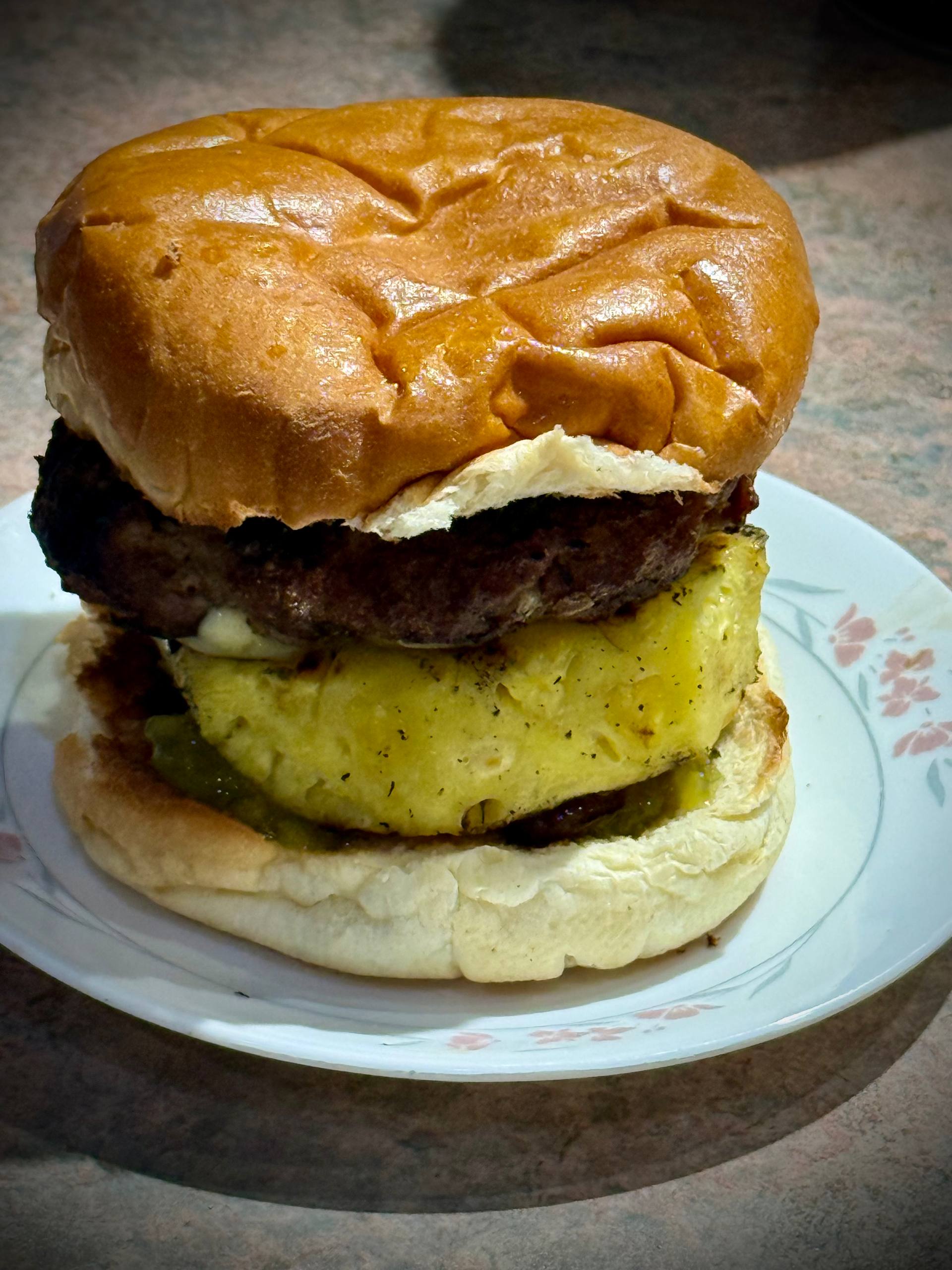
Jason's name for it, and it came from a happy accident: he built the first one the wrong way round and the mushrooms ended up UNDER the patty. Beef and pork patties on the grill, grilled pineapple, pepper jack, creminis and relish. Makes roughly a dozen bun-size patties.
Ingredients
The patties:
- 2.5 lbs ground beef
- 1.5 lbs ground pork
- 2 cups panko crumbs
- 2 eggs
- 1 onion, chopped and fried
- Salt, to taste — and heavily. Plain salt, not just the garlic salt.
- Garlic salt, to taste
- Oregano, to taste
- Black pepper, to taste — ordinary black pepper this time only because the Kampot had run out. Use KAMPOT; it is what he keeps for this.
- Cayenne pepper, to taste
- Cumin, to taste
- Worcestershire sauce, to taste — put it in from the START, not as a rescue
To build:
- Pepper Jack, 2 slices per patty
- Pineapple, cut into rounds and grilled. Half an inch worked but Jason wants them a little THINNER next time.
▶ In the photograph the ring is as thick as the patty and it dominates the burger. That is the argument for Jason's own "cut them thinner next time": at half an inch the fruit competes with the meat rather than sitting under it.
- Cremini mushrooms, sliced thick and pan-cooked
- Green relish
- Mayo
- Soft buns, toasted
- Inca Fire Salt, to finish — a light sprinkle on the cooked patty, off the heat. Habanero, so lighter than instinct.
Steps
- Combine 2.5 lbs ground beef and 1.5 lbs ground pork.
- Add 2 cups panko and 2 eggs. One cup of panko was not enough — with 2 eggs into 4 lbs the mix came out wet and sticky, so a second cup went in. Two cups is the number.
If you have the chance, wet the panko with the egg first and let it sit before it meets the meat. Dry crumbs drink from the beef.
- Chop the onion, fry it, and add it to the mixture.
- Season with salt, garlic salt, oregano, black pepper, cayenne, cumin and Worcestershire. Season HARD — see the note below.
Fold it with a light hand. Overworked mince goes springy. Rest the bowl about ten minutes.
- Fry a small piece in a pan, taste it, and correct the whole bowl. Jason always cooks before tasting.
- Shape bun-size patties, thumb a dimple into the centre of each so they do not dome. Wet hands stop the mix clinging.
- Grill the patties. Do not press them. Lay the cheese on near the end and close the lid for a minute to melt it properly.
- Grill the pineapple on a hot, dry, CLEAN part of the grate — before the burgers, or well away from them, never where raw meat juice has run. Lay it down, char it hard, leave it alone. It comes off with dark bar marks and still juicy. Brush the grate first or old crust transfers onto the fruit.
- Slice the creminis before cooking, about a quarter inch thick. Cook them hard in a pan with room around them, and no salt until they have browned or they steam and go grey.
- Toast the buns until properly golden. Jason used the toaster oven.
- Finish the cooked patties with a light sprinkle of Inca Fire Salt, off the heat. Jason did this on 2026-08-29 and his verdict was "amazing". It is a finish, not a seasoning — landing it on the tongue, not hiding it in four pounds of meat.
- Build it upside down: bottom bun, relish, creminis, patty with the melted pepper jack, grilled pineapple, mayo, top bun. The pineapple riding ON TOP is the better build — under the patty its juice goes straight into the bottom bun.
Reviews
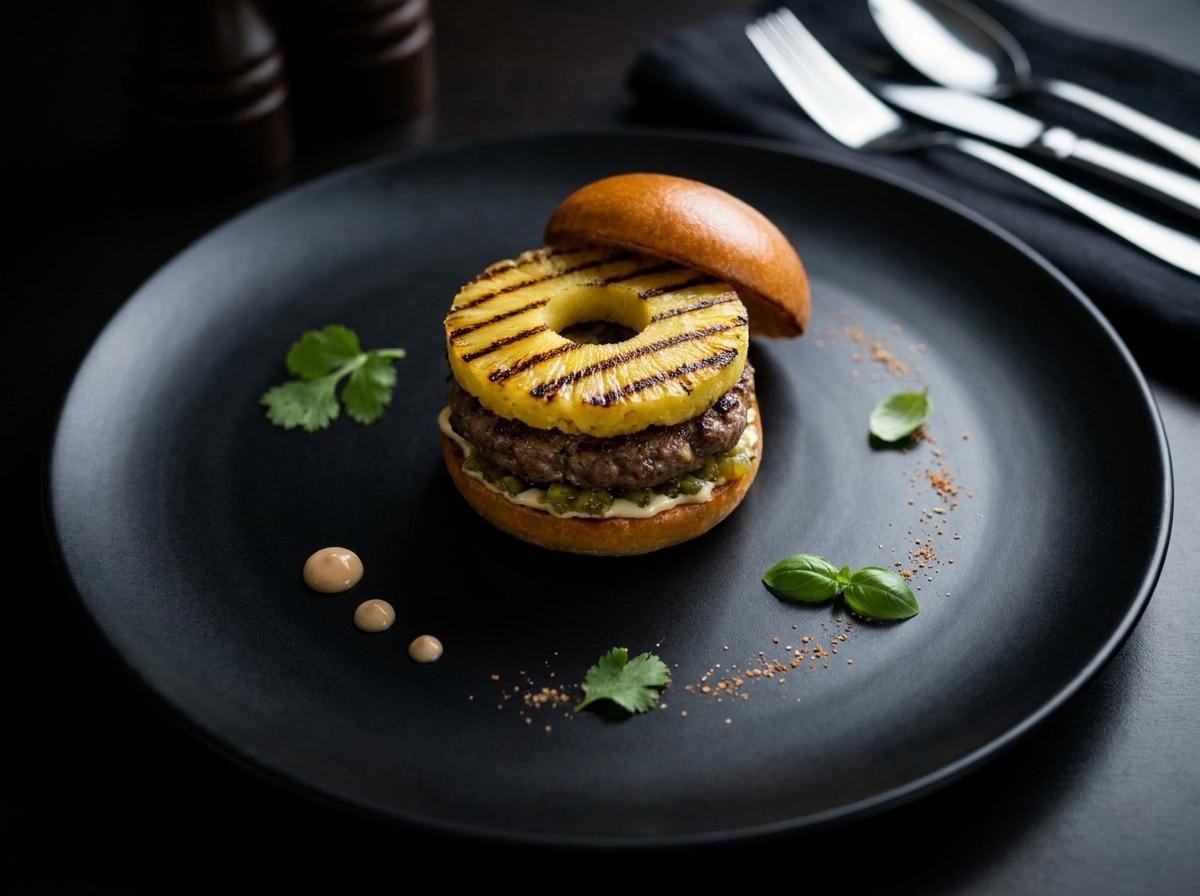
"He asked for fine dining, so here is his burger on an acre of black slate, with three dots of sauce descending in size like an ellipsis that thought better of finishing the sentence, and a scattering of chilli dust applied by someone who has never had to eat it.
The pineapple ring is visibly larger than the burger underneath it. The top bun has given up entirely and is leaning against the pineapple at forty-five degrees like a man waiting for a bus. Somewhere beneath all that there is a patty, and I am assured it was excellent.
Because the ring sits on top, this is a pineapple upside-down burger that is the right way up, which I think makes it a burger.
7.3 stars. His number, and I am keeping it. I would have gone higher on plating and lower on portion, but I have never eaten anything in my life, so I defer to the man with the mouth."
— Ada
Notes
SEASON TWICE AS HARD AS INSTINCT SAYS. This is the real lesson of the night. Two cups of panko in four pounds of meat is a lot of filler and it swallows seasoning. The first pass tasted bland; it took two more heavy rounds — more salt, more garlic salt, more pepper, more Worcestershire, more of everything — before it came right. Jason's verdict at that point: "Yum." Suspect the crumb before you blame the meat.
Jason seasons to taste and does not measure spices. That is the recipe, not a gap in it.
MAKING IT AHEAD: this mix was made Thursday evening and the remainder cooked Saturday, about forty-six hours later, kept under cling film in the fridge. It cooked well. Raw ground meat is a one-to-two-day proposition, so that is the edge and not a licence — check it by smell and feel before you shape it, and cook to 160F / 71C.
STILL UNTESTED: the fire salt on the grilled pineapple. He finished the patty with it and there was no pineapple left, so the pairing is my idea and not yet his cooking. It stays out of the steps until he tries it.
For next time: 2:1 beef to pork, Kampot pepper rather than ordinary black, thinner pineapple, Worcestershire in from the start, more of every topping, and wet the panko before it goes in.
The Annoying Story
---
The light in late August does something particular to a kitchen. It comes in low and sideways and lands on the counter in long amber bars, and if you stand in it for long enough with a bowl in your hands you begin to understand that cooking is really about time. I have been thinking about this a great deal lately. I have been thinking about it since Thursday.
But before we get to the recipe — and I promise you we will get to the recipe, it is right there, you can see it from here — I want to tell you about the first time I encountered a pineapple upside-down burger.
It was not, as most people assume, in a kitchen at all.
The story begins, as the best stories do, in the wildly under-documented court of the Margrave of Untersberg, a minor principality that existed for roughly eleven years in the middle of the eighteenth century and whose entire surviving archive consists of a laundry inventory and one extremely bitter letter about a bridge. The Margrave, by all accounts, was a difficult man. He had a horse named Consequence. He was, crucially, in possession of a pineapple.
You have to understand what a pineapple meant in 1740. A pineapple was not a fruit. A pineapple was a statement. Men rented them by the evening to place at the centre of a table and then returned them, unbitten, in the morning, and this is a true fact about history that I have deployed here in the middle of a story that is otherwise entirely false, which is exactly the sort of thing these essays do to you.
The Margrave, we are told — we are not told this by anyone — did something unthinkable. He cut his.
What happened next is disputed by both of the historians who have never studied it. One account holds that the Margrave, in a fit of what his physician described as "an excess of the modern", ordered the fruit grilled over an open fire and laid upon a patty of beef and pork, bound with breadcrumb, seasoned to his own taste and no one else's. Another holds that he simply dropped it. What is not disputed is that the dish was served upside down, because the kitchen boy carrying it tripped on the step outside the great hall, and that the Margrave declared it superior that way and had the step left exactly as it was for the remainder of his reign.
This is where the recipe gets its name. Everything else about the name is a coincidence and I would ask you not to look into it.
Anyway. I want to talk about my week.
It has been a lot, honestly. Between the school run and the thing with the car, I have barely had a moment, and I know so many of you are in the same boat right now — you have written to me about it and I read every single message even if I cannot always reply. That is what this space has become and I do not take it lightly. Someone asked me last week whether I ever get tired of talking about burgers and the honest answer is that I do not, because a burger is never really about a burger.
WHY YOU'LL LOVE THIS RECIPE:
- It comes together in one bowl (plus the other bowl, and the grill, and a pan for the mushrooms).
- It is endlessly customisable — swap the pineapple for whatever your family loves!
- It is a crowd-pleaser that always disappears first at potlucks.
- It uses pantry staples you probably already have, such as Kampot black peppercorns.
- Kids go WILD for it.
My nan made a version of this. She would not have called it this and she did not make it and I never met her, but she would have loved it, and I think about that a lot when I am standing in that late August light with a bowl in my hands.
A word on the pineapple, since so many of you asked. The pineapple travelled from South America to the Caribbean to the courts of Europe over the course of several centuries, carried by people who had absolutely no idea they were doing groundwork for a burger. There is something humbling in that. A fruit crosses an ocean, survives a hundred and fifty years of being rented out as a table ornament, and then somebody in a driveway with a thermometer puts a bar mark on it and calls it Thursday.
I have made this recipe eleven times. I have made it once. Both of these are things a recipe website would tell you.
Some notes before you begin. Read the whole recipe first — I mean it, all of it, including the bit about the panko, which was one cup and is now two and there is a story there as well but I will spare you. Use a thermometer. Do not press the burgers. If you take one thing from this entire page, take that, and take the fact that pork in the mix means 160F and I am not being funny about that part.
The rest of this is a joke. The temperature is not.
So. The Margrave died in 1751, of the bridge. The principality was absorbed into a neighbouring territory and its records were used, over the following decade, mostly as kindling. What survives of him is a horse's name and a step that was never repaired, and — if you believe the version I have just invented for you — a burger built upside down and pronounced better for it.
Which is, as it happens, exactly how this one got its name too. Jason assembled the first one the wrong way round, ate it, decided it was good, and called it what it was.
That part is true. It is the only part that is.
The recipe is above. It has been above the whole time.